How a Single Laser Cleans Heavy Soot, Carbon Deposits, and Aviation Grime
Why Carbon Deposits Are Different
Engine and exhaust contamination isn't just dirt. It's a metallurgical mess: hydrocarbons partially combusted into aromatic carbon ring structures, mixed with metal oxides from the substrate, baked at 400–800 °C, and pressed into the substrate by years of thermal cycling. The result is a tenacious black or brown layer that:
- Doesn't dissolve in standard solvents
- Resists mechanical cleaning because it's harder than the underlying paint
- Can't be media-blasted aggressively because the substrate is often thin (cowling skin, exhaust shrouds)
- Hides corrosion pitting beneath it that needs to be assessed before priming
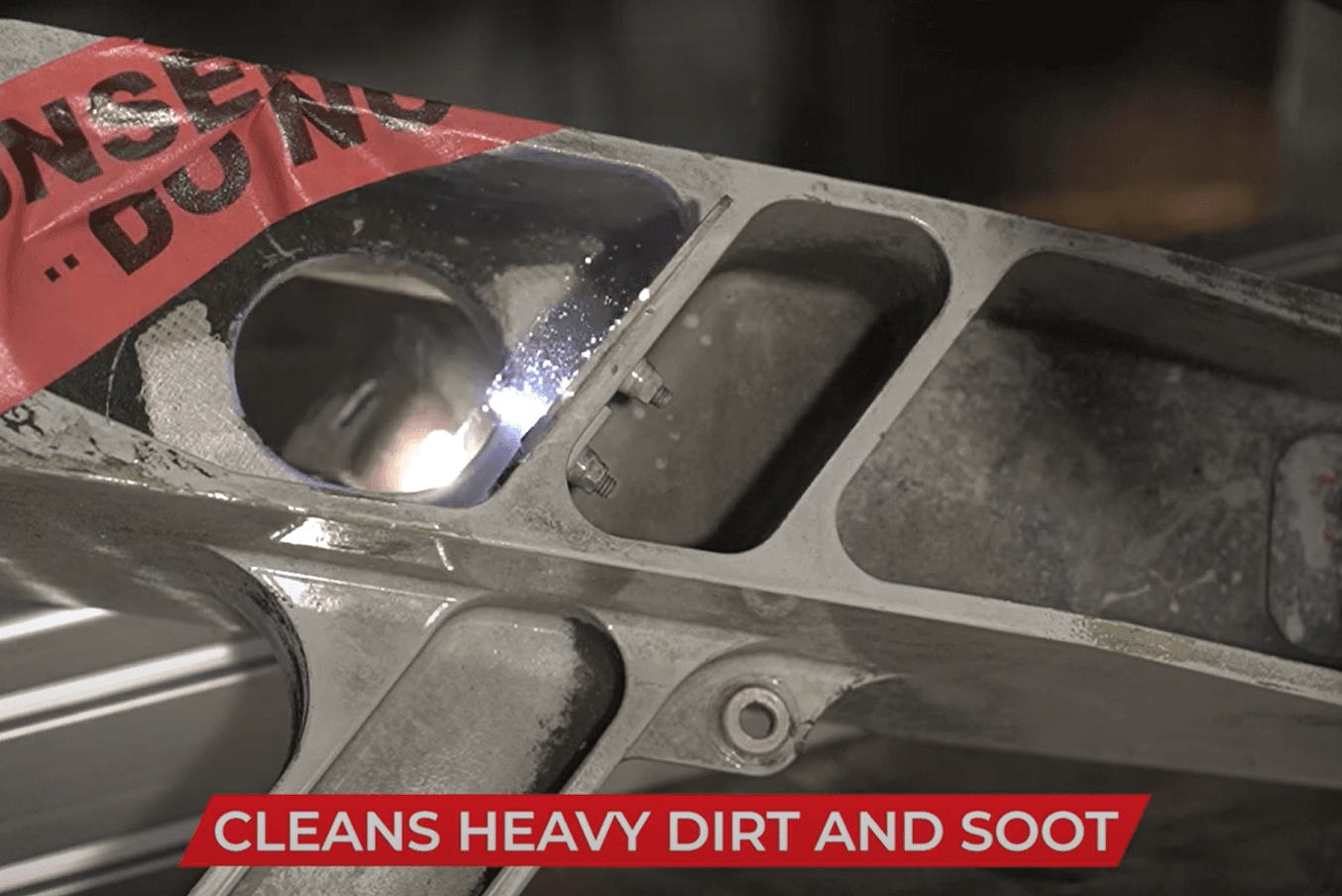
This is the application where laser cleaning shows the largest productivity advantage over traditional methods.
Why the FP-300 Excels Here
Carbon deposits are nearly black — they absorb 90–95% of 1064 nm energy. Aluminum substrate, by contrast, reflects 90–95% of the same energy. The selectivity ratio for soot-on-aluminum is the highest of any aviation application, even higher than primer-on-aluminum. That means:
- Lower fluence is needed (1–3 J/cm² vs. 5 J/cm² for primer)
- Higher safety margin (100× instead of 60×)
- Faster scan speeds at the same removal rate
- Multi-layer carbon comes off in single passes that would need multiple passes for paint
Recommended Parameters by Deposit Type
Light Carbon Bloom (oxidation discoloration)
| Power | 120 W |
| Pulse duration | 60 ns |
| Repetition rate | 50 kHz |
| Scan speed | 500 mm/s |
| Passes | 1 |
Moderate Soot (engine cowling interior)
| Power | 180 W |
| Pulse duration | 80 ns |
| Repetition rate | 40 kHz |
| Scan speed | 350 mm/s |
| Passes | 2 |
Heavy Baked-On Carbon (exhaust stack interior, APU bay)
| Power | 240 W |
| Pulse duration | 120 ns |
| Repetition rate | 30 kHz |
| Scan speed | 250 mm/s |
| Passes | 3–4 |
The Inspection Bonus
One of the underappreciated benefits of laser cleaning carbon-coated parts: it reveals subsurface defects that were hidden under the carbon. Stress cracks, weld discontinuities, fatigue indications — all invisible under heavy soot, all clearly visible after a clean laser pass.
Several engine shops have reported finding cracks during routine carbon removal that would have been missed by other methods. The cleaning step doubles as an NDI prep step, and the eddy-current or dye-penetrant inspection that follows is much more sensitive on a properly cleaned surface.
Specific Aviation Applications
Engine Cowling Interior
The inside of a cowling sees engine heat, oil mist, and exhaust streamers. Laser cleaning at 180 W with 2 passes typically returns the surface to bare aluminum tone in 15–20 minutes for a Cessna-sized cowling.
Exhaust Stack Exterior
Stainless steel exhaust components have a different parameter window than aluminum (higher absorption, lower thermal conductivity). Drop power to 150 W, raise pulse duration to 150 ns, slow the scan to 200 mm/s. Watch substrate temperature carefully — stainless can discolor permanently above 250 °C.
APU Bay Interior
The APU bay typically has a mix of aluminum, stainless, and composite components. Park the FP-300 outside the bay with the cleaning head on a long-reach mount, and clean each material with its appropriate parameter set. Keep the laser off composites if their thermal limits are tighter than the aluminum's.
Landing Gear Components
Brake dust and oil/grime accumulate on landing gear struts and wheels. Laser cleaning is ideal here because the parts often have anodized or chromated surfaces that aggressive media would strip. The FP-300 removes the dirt without touching the protective coating beneath.
Fume Extraction Considerations
Carbon ablation generates more fume volume than paint ablation — the carbon becomes airborne PAH compounds and fine particulate. Make sure the HEPA/activated carbon filtration is fresh before starting heavy soot work, and plan on shorter filter intervals than normal:
- Pre-filter (MERV 8): change after every 4–6 hours of soot work
- HEPA (MERV 17): change quarterly under heavy soot use vs. semi-annually for paint
- Activated carbon: change semi-annually under heavy soot use vs. annually otherwise
The total filter cost increases roughly 50% for heavy soot operations, but it's still a fraction of the cost of operating a wet blast cabinet for the same work.
Documentation Notes
For maintenance records on engine and exhaust components, document:
- Component identification and TSN/CSN
- Pre-clean photographs of the contaminated surface
- Parameters used (power, pulse, frequency, speed, passes)
- Post-clean photographs at standard distance
- Any defects revealed by the cleaning (with separate disposition)
- Final condition for return to service or further repair
The before/after photo pair is particularly valuable for engine and exhaust work — the visual difference is dramatic, and it gives operators and inspectors immediate confidence in the process.