Class IV Laser Safety Fundamentals for MRO Operations
Why Class IV?
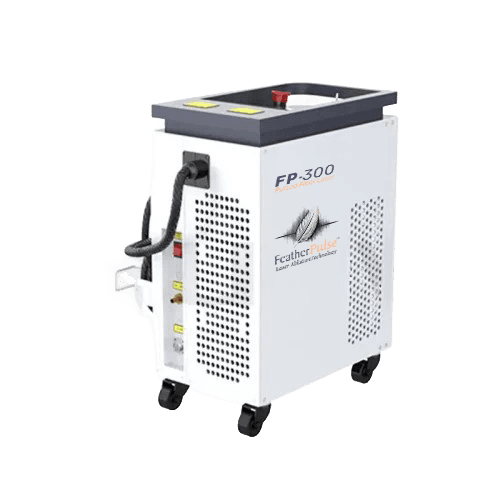
The FDA/CDRH classifies lasers based on their potential to cause harm. The FP-300, with average power above 500 mW, falls into Class IV — the highest hazard class, the same one that covers surgical lasers, industrial cutting systems, and military rangefinders.
Class IV demands respect, but the classification doesn't mean the laser is inherently more dangerous than a chemical stripper. It means the controls have to be engineered, not improvised. The FP-300's safety record bears this out: zero injuries to date across all field deployments. Compare that to the chemical stripping industry's roughly 3,400 injuries per year.
The Maximum Permissible Exposure (MPE)
For 1064 nm light at 100 ns pulses, the MPE — the highest exposure considered safe — is 5 × 10⁻⁷ J/cm². The FP-300 delivers 3 × 10⁻² J/cm² per pulse at the workpiece. That's 60,000× over the MPE.
That sounds alarming, but in context: chemical strippers are infinitely over their safe exposure (which is zero). The MPE just tells you how seriously to take direct beam exposure. Engineering controls eliminate the risk entirely.
The Nominal Hazard Zone
The Nominal Hazard Zone (NHZ) is the area within which the laser exceeds the MPE. For a 300 W beam with 10 mrad divergence, the NHZ for a direct, in-line view of the beam is approximately 4,900 meters. For diffuse reflections off a painted surface, the NHZ collapses to 2.5 meters. Off bare aluminum (specular surface), the NHZ for reflected energy is again 4,900 meters.
This is why the FP-300 is operated inside a controlled area with barriers. The barriers don't have to be elaborate — a 10×10 ft work zone with laser curtains and a 15×15 ft safety zone is sufficient for most hangar operations.
The Hierarchy of Controls
OSHA and ANSI Z136.1 define a control hierarchy that applies directly to the FP-300:
1. Engineering Controls (Most Effective)
- Enclosed beam path on the cleaning head
- Interlocked barriers — if the door opens, the laser shuts off
- Beam stops at the perimeter of the work area
- Emission indicators (red LEDs visible from any approach)
- Automatic shutdown on temperature, back-reflection, or interlock fault
2. Administrative Controls
- Standard Operating Procedures (SOPs) for startup, operation, shutdown
- Operator training and certification (16-hour basic, 32-hour advanced)
- Authorized operator list with annual recertification
- Warning signs at all entries to the controlled area
3. Personal Protective Equipment (Least Effective)
- Laser safety eyewear: OD 6+ at 1064 nm, ANSI Z87.1 impact rated
- Face shield for UV/blue secondary emission from plasma plume
- Long sleeves, closed shoes, no synthetic fabrics near the beam
- N95 respirator during filter changes (HEPA captures 99.95% of particles during operation)
The Seven Independent Interlocks
The FP-300 has seven safety interlocks that must all be in agreement before the laser will fire:
- Key switch in ON position
- Emergency stop circuit not triggered
- Door interlock closed
- Beam shutter open
- Power within set limits
- Temperature within set limits
- Back-reflection sensor below threshold
If any single interlock fails, the laser disables instantly. There is no way to "bypass" interlocks during normal operation — the system doesn't expose that as a setting.
Why Engineering Controls Beat PPE Every Time
At T&P Aero's installation, the FP-300 is fully enclosed during operation. Operators wear safety eyewear as a backup, but the primary protection is the enclosure. That's the right philosophy: PPE is the last line of defense, not the first. A pair of safety glasses can crack, fog up, or simply be forgotten. An engineered enclosure is always there.
The shocking statistic from the industry: chemical stripping injures 3,400 workers per year. Media blasting injures another 1,200. Laser cleaning across all industries reports just 12 injuries per year. The FP-300, specifically, is at zero. That's not luck — it's the inevitable result of engineering controls done right.